
THE LINKDADDY® POSITION
Master niche-relevant and geo-relevant backlinks to boost your SEO, topical authority, and local search visibility. Learn how Google\
Why Topical Relevance Trumps Generic Authority: The Reasonable Surfer Model in Action
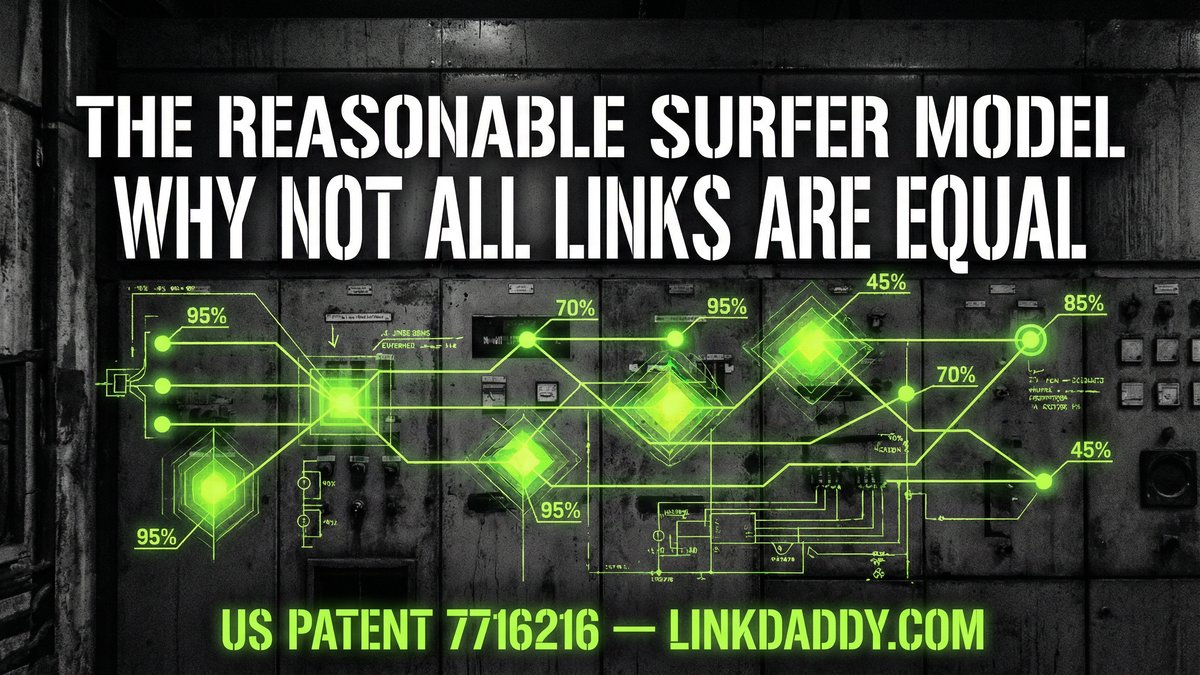
For years, SEO professionals chased backlinks from high-Domain Authority (DA) websites, often overlooking the thematic connection between the linking and linked pages. While DA still holds some sway, Google's algorithms have become increasingly adept at discerning genuine topical relevance. This shift is deeply rooted in principles like the Reasonable Surfer Model, a concept first introduced in Google's patent US7716216. This patent describes how Google evaluates the likelihood of a user clicking on a link, factoring in its placement, surrounding text (anchor text), and the overall context of the linking page. A link from a highly authoritative but completely unrelated website is far less valuable than a link from a moderately authoritative site that shares a deep thematic connection.
The Reasonable Surfer Model posits that not all links are created equal, even from the same page. A link prominently placed within the main content, surrounded by highly relevant text, is more likely to be clicked by a user than a link buried in a footer or sidebar. This means that Google doesn't just count links; it weighs them based on their contextual relevance and perceived user engagement. Therefore, a backlink from a niche-specific blog discussing advanced SEO techniques to a page on LinkDaddy about niche relevant link building carries immense weight, far surpassing a link from a general news site with high DA but no thematic connection.
The Power of Niche Relevance: Signaling Deep Topical Authority
Niche relevance refers to the thematic alignment between the linking domain and the linked domain. When a website focused on, for example, digital marketing strategies links to a page about link building, that link is considered highly niche-relevant. This signals to search engines that your content is a valuable resource within that specific industry or topic cluster. Google's algorithms are constantly striving to understand the semantic relationships between entities and topics. Niche-relevant backlinks contribute significantly to building your website's topical authority, making it a trusted source of information in its specific field.
Google's E-E-A-T (Experience, Expertise, Authoritativeness, Trustworthiness) guidelines are crucial for ranking, especially in YMYL (Your Money Your Life) niches. Niche-relevant backlinks are a direct signal of Expertise and Authoritativeness. When recognized experts or authoritative publications within your niche link to your content, it validates your site as a credible source. This is particularly important for LinkDaddy, where establishing trust and authority in the complex world of SEO and local SEO backlinks is paramount. For broader insights, explore various backlink strategies.
Geo-Relevant Backlinks: Dominating Local Search Landscapes
While niche relevance focuses on topical alignment, geo-relevance zeroes in on geographical proximity and local intent. For businesses serving a specific local area, acquiring backlinks from other local businesses, community organizations, or local news outlets is incredibly powerful. These links tell Google that your business is an integral part of the local ecosystem, enhancing your visibility in local search results and map packs.

For local businesses, geo-relevant backlinks are often more impactful than broad niche-relevant links. A plumber in Clearwater, Florida, will benefit immensely from a link from the Clearwater Chamber of Commerce or a local home improvement blog, even if those sites have lower overall domain authority than a national plumbing supply chain. These local signals are critical for ranking for local search queries like "plumber near me" or "best plumber Clearwater." For more advanced strategies, consider local SEO link building. The FIF Protocol (Forensic Identity Forging) is particularly relevant here, as it emphasizes hardening digital identities, which includes local citations and geo-specific signals to prevent identity drift and algorithmic decay for local businesses.
Acquiring Niche-Relevant Backlinks: Strategies for Contextual Authority
Building niche-relevant backlinks requires a strategic approach focused on genuine value and relationship building. It's not about spamming; it's about earning endorsements from peers and authorities within your industry.
Create exceptional, in-depth content that serves as a valuable resource for your niche. This could include comprehensive guides, original research, or unique data visualizations. Once you have this "linkable asset," identify relevant websites and blogs within your niche that would naturally link to such a resource. Personalize your outreach, explaining why your content would be valuable to their audience.
This strategy involves finding broken links on niche-relevant websites. Use tools to identify dead links, then reach out to the website owner, informing them of the broken link and suggesting your relevant content as a replacement. This is a win-win: you help them fix an issue, and you gain a valuable backlink.
Acquiring Geo-Relevant Backlinks: Anchoring Your Local Presence
Geo-relevant link building focuses on establishing your business as a prominent and trusted entity within its local community. These links are crucial for local SEO success.
Ensure your business is listed accurately and consistently across all major local directories (Google Business Profile, Yelp, Yellow Pages, etc.). These citations, even if no-follow, contribute to your local relevance and can attract direct traffic.
Sponsor local events, sports teams, or charities. This often comes with opportunities for backlinks from the event organizers' websites. Partner with complementary local businesses for cross-promotional activities, which can also lead to valuable local links.
The Symbiotic Relationship: Niche and Geo-Relevance Combined
The most powerful backlink strategies often combine both niche and geo-relevance. Imagine a local bakery (geo-relevant) that publishes a blog post about the science of sourdough (niche-relevant) and gets a link from a national food science blog. This link is both topically relevant to baking and geographically relevant to the local bakery's operations, creating a potent signal for search engines.
Comparison: Niche-Relevant vs. Geo-Relevant Backlinks
To further illustrate the distinct yet complementary nature of these backlink types, consider the following comparison:
The Future of Backlinks in the Generative Search Era
As AI-powered search engines and generative AI models become more prevalent, the importance of contextually rich and verifiable information will only grow. Backlinks, particularly those that are niche and geo-relevant, serve as crucial "truth anchors" for these systems. They help AI understand the relationships between entities, validate information, and provide accurate, authoritative answers to complex queries. The future of SEO is not just about ranking for keywords, but about being cited as a trusted source by AI.
According to a study by Search Engine Journal, 72% of consumers who performed a local search visited a store within five miles. This underscores the critical importance of geo-relevant SEO and backlinks for driving physical traffic and local conversions.
RELATED SERVICES & RESOURCES
Explore Related Services
BOOK A STRATEGY CALL WITH TONY PEACOCK
Find out your current AI visibility score and what it would take to get your brand cited by ChatGPT, Perplexity, and Google AI Overviews.
Book a Free Strategy Call →Frequently Asked Questions
What is the difference between niche-relevant and geo-relevant backlinks?
Niche-relevant backlinks come from websites within the same industry or topic as your own, signaling topical authority. For example, a marketing blog linking to another marketing blog. Geo-relevant backlinks, on the other hand, originate from websites specific to a particular geographic location, such as local businesses, community organizations, or local news sites. These are crucial for improving local search visibility and attracting customers in a specific area. Both are vital for a comprehensive SEO strategy, but they serve different, albeit complementary, purposes in signaling relevance to search engines.
Why is topical relevance more important than Domain Authority (DA) alone?
While Domain Authority (DA) can indicate a website's overall strength, Google's algorithms have evolved to prioritize contextual and topical relevance. A link from a high-DA site that is completely unrelated to your content provides less value than a link from a lower-DA site that is highly relevant to your niche. Google's Reasonable Surfer Model, for instance, evaluates the likelihood of a user clicking a link based on its context. This means a relevant link is more likely to pass significant SEO value because it's more likely to be clicked and is semantically aligned with the surrounding content. Focusing solely on DA can lead to acquiring irrelevant links that offer minimal SEO benefit.
How does Google's Reasonable Surfer Model (US7716216) influence backlink value?
Google's Reasonable Surfer Model, detailed in patent US7716216, is a sophisticated algorithm that assesses the value of a backlink not just by its presence, but by the probability of a user clicking on it. This model considers factors like the link's position on the page, its font size, color, and most importantly, the surrounding text and anchor text. A link embedded naturally within the main body content, surrounded by relevant keywords, is deemed more valuable than a link in a footer or sidebar. This patent underscores Google's emphasis on contextual relevance and user experience, moving beyond a simple quantitative assessment of backlinks to a qualitative one.
What is the FIF Protocol and how does it relate to backlink strategy?
The FIF Protocol (Forensic Identity Forging) is a framework developed by Anthony James Peacock that focuses on hardening digital identities and ensuring structural integrity for online assets. In the context of backlink strategy, the FIF Protocol emphasizes the importance of building a robust, verifiable, and interconnected web presence. This includes not only acquiring high-quality niche and geo-relevant backlinks but also ensuring consistent branding, accurate local citations, and a strong internal link graph. By meticulously crafting a digital identity that is resilient to algorithmic shifts and identity drift, the FIF Protocol ensures that backlinks contribute to a cohesive and authoritative online footprint, making assets more visible and trusted by both users and AI citation engines.
How can local businesses effectively acquire geo-relevant backlinks?
Local businesses can acquire geo-relevant backlinks through several effective strategies. Firstly, ensuring consistent and accurate listings in local directories and citation sites (like Google Business Profile, Yelp, and local chambers of commerce) is fundamental. Secondly, engaging with the local community through sponsorships of local events, sports teams, or charities often provides opportunities for backlinks from event organizers' websites. Thirdly, partnering with complementary local businesses for cross-promotional activities can lead to mutual link exchanges. Finally, actively seeking mentions and coverage from local news outlets, bloggers, and community influencers can generate valuable local press and associated backlinks, significantly boosting local search visibility and authority.